A Winter Line on Krcin
Early in the winter season of 2025/26, we opened a new route on the northwest rock below the summit of Krcin, in the Korab mountain massif.
We started moving in the dark, leaving the valley behind and letting our bodies slowly wake up. We crossed small streams, stepped over fallen trees, and moved quietly through a forest still untouched by snow. Fallen leaves covered the ground, reminding us that autumn hadn’t fully let go yet. Elena, Nikola, and I were heading toward the mountain with a simple plan: to explore the climbing possibilities on the northwest rock of Krcin’s summit. Friends had been there before, and their stories stayed with us. Still, at that moment, we had no intention of climbing anything new. The idea was to follow the main couloir that leads past the rock and up to the summit.
The approach is long. It takes more than three hours to reach the base of the wall, and that day, everything aligned in our favour. No wind, no cold, no clouds. As soon as we exited the forest, we knew it would be a good day in the mountains. To reach the rock—hidden on the opposite side of our approach—we climbed a hill that isn’t part of the normal route to the summit. From there, we traversed to the other side of the mountain and began descending toward the face.
The moment we crossed over, we felt the power of the north. The wind arrived suddenly, sharp and cold. Gloves and shells came back on as we carefully downclimbed steep terrain. Slowly, the northwest rock of Krcin revealed itself. I stopped for a moment, just a few steps into the descent, and looked. Really looked. From that angle, something made sense. A line appeared—logical, clean, climbable. I didn’t say much, but I knew.
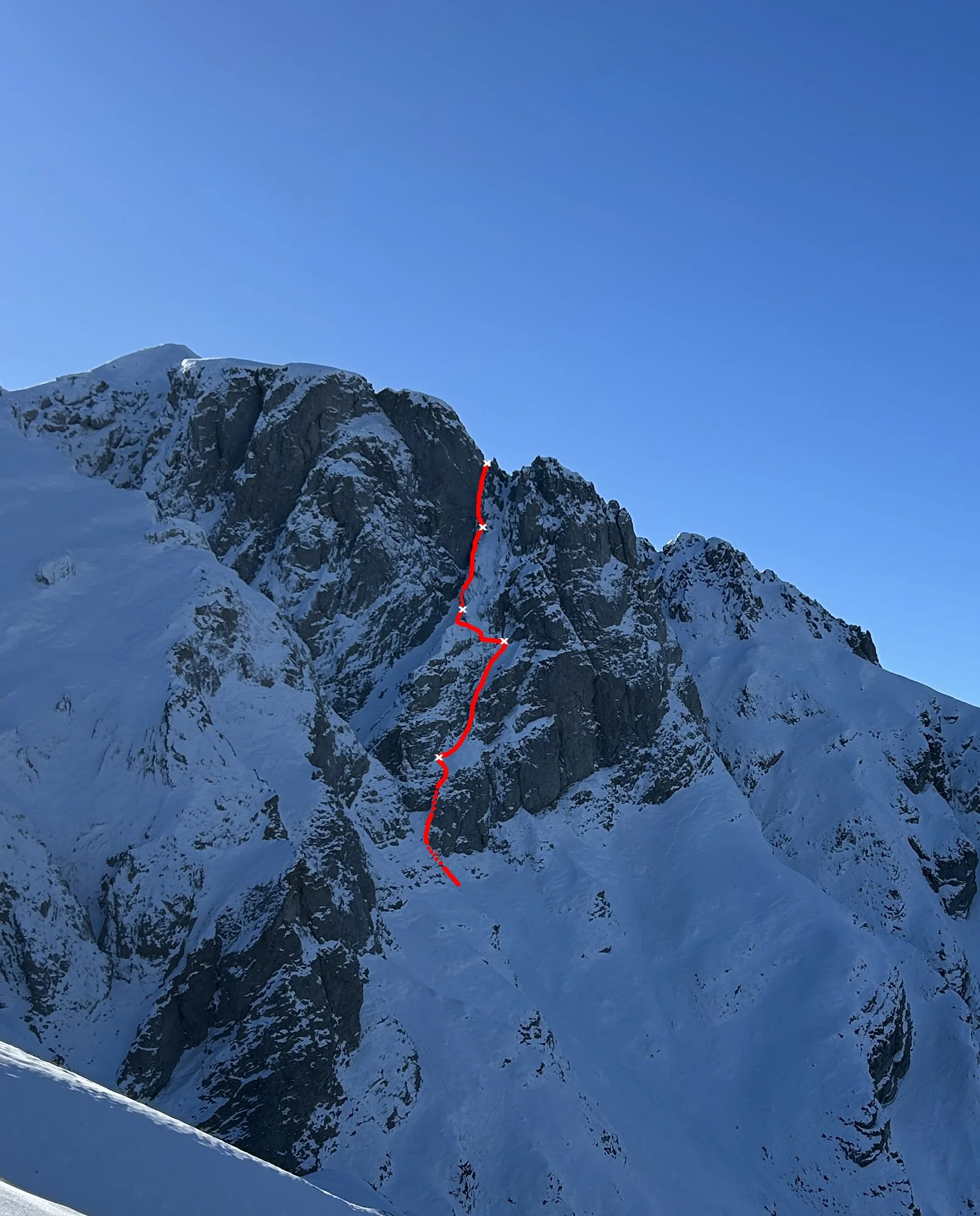
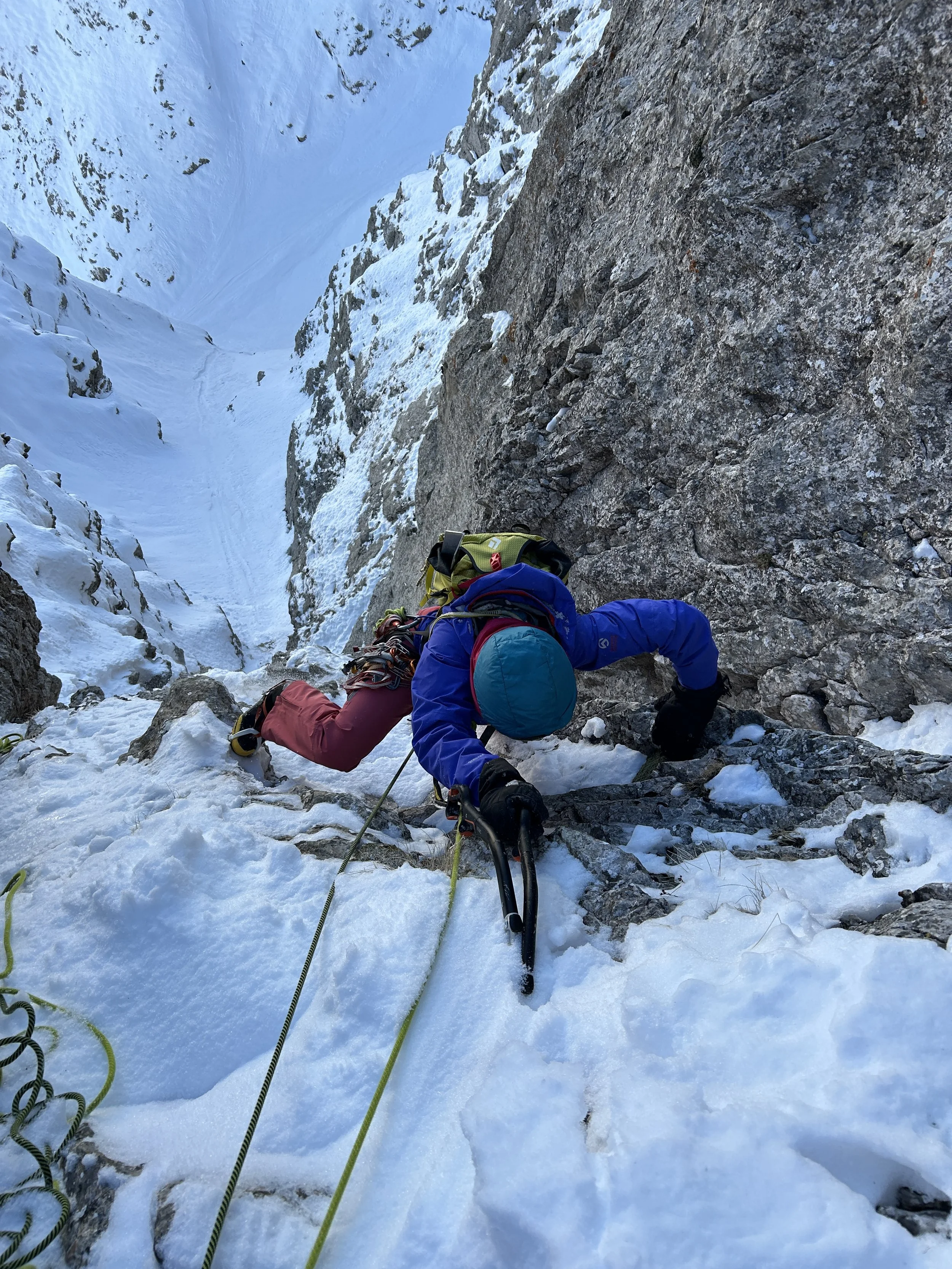
The first pitch starts on a steep snowfield and leads into a small dihedral, where I placed the first piton. It wasn’t technically hard, but it required three or four exposed moves above protection. After passing that section, a large wall appeared on my left—a perfect place for the first anchor. We regrouped there.
The second pitch was very logical. To the right, a steep snowfield dropped away—no option there. To the left, the wall blocked progress. The only way up was a clear, visible dihedral. This pitch was longer and slightly harder than the first. I placed three pieces of protection, including one piton. Some moves demanded extreme care: balancing on the very tips of my crampons, ice axes placed awkwardly, body pressed close to the rock. As I climbed higher, better protection options appeared, and I could finally breathe again. The pitch ended on a steep snowfield below an obvious rock, where we built the second anchor.
Above us, the line became complicated. A huge roof blocked the way forward—completely unclimbable. The only option was a delicate traverse to the left across a slab of snow. The first moves were slow and precise. Then I found a crack. I placed a piece. “Ohhh,” I said out loud. Not relief—it is just mental support. A few careful moves later, I reached a small snowy ridge that allowed access to the other side. There, I found a rock and built the third anchor. The pitch was short, but mentally demanding.
The next pitch was clearly the crux. We all felt it. A straight line on mostly bare rock, with very little snow. Excitement rushed through me. I checked my harness—everything was where it should be. After ten meters of climbing, I reached an overhang. The good thing was that it offered several protection options. I secured the section carefully, placing two cams in different cracks before committing. Still, it wasn’t easy.
Cold became the new normal, and we adjusted our layers again. After a short traverse, we finally stood below the rock. It had taken us around three and a half hours to reach the base of the main couloir. There, we talked about the line we had noticed earlier. Conditions were good: not too much snow, most of the rock visible. After a brief pause, we roped up.
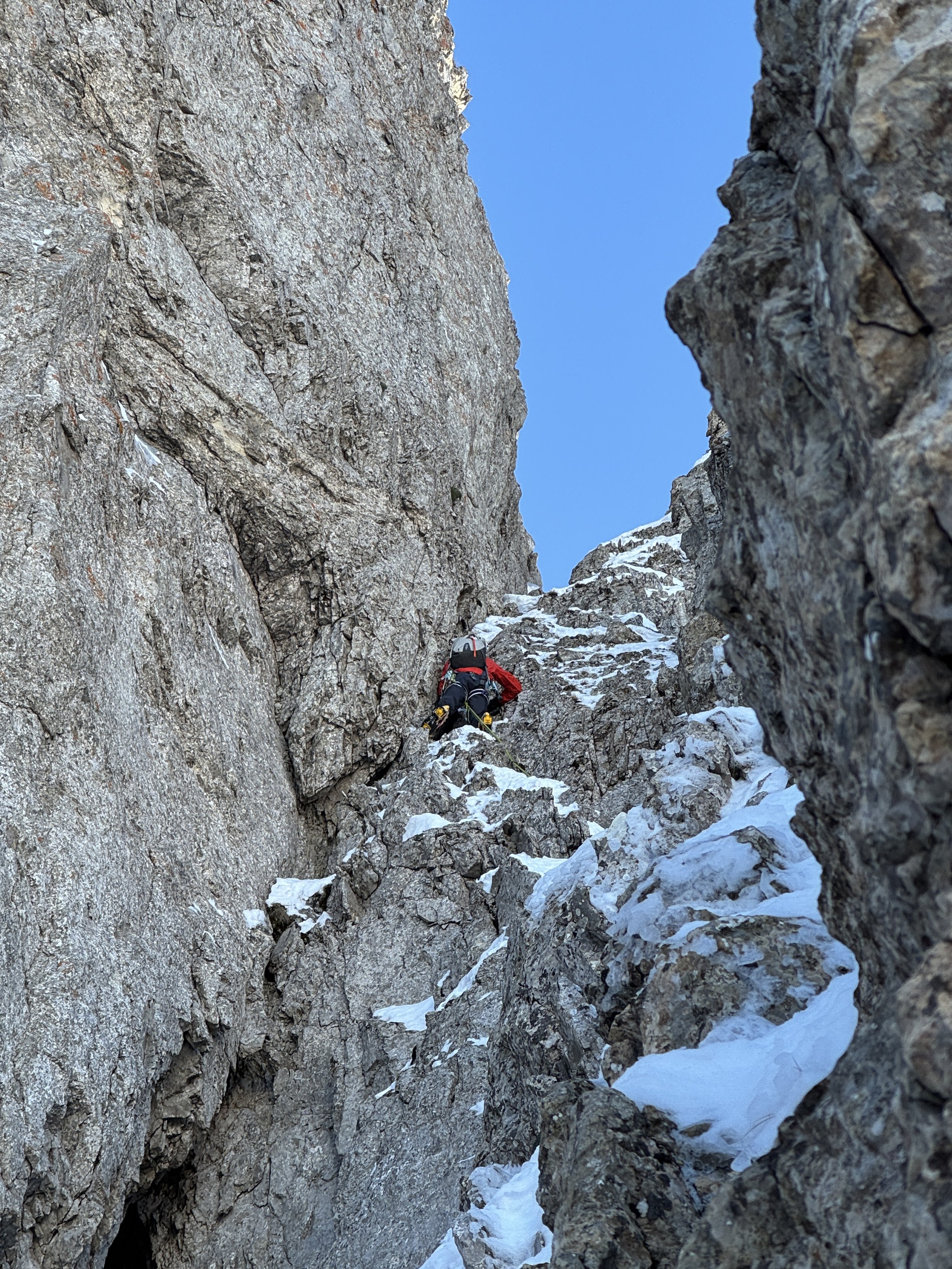
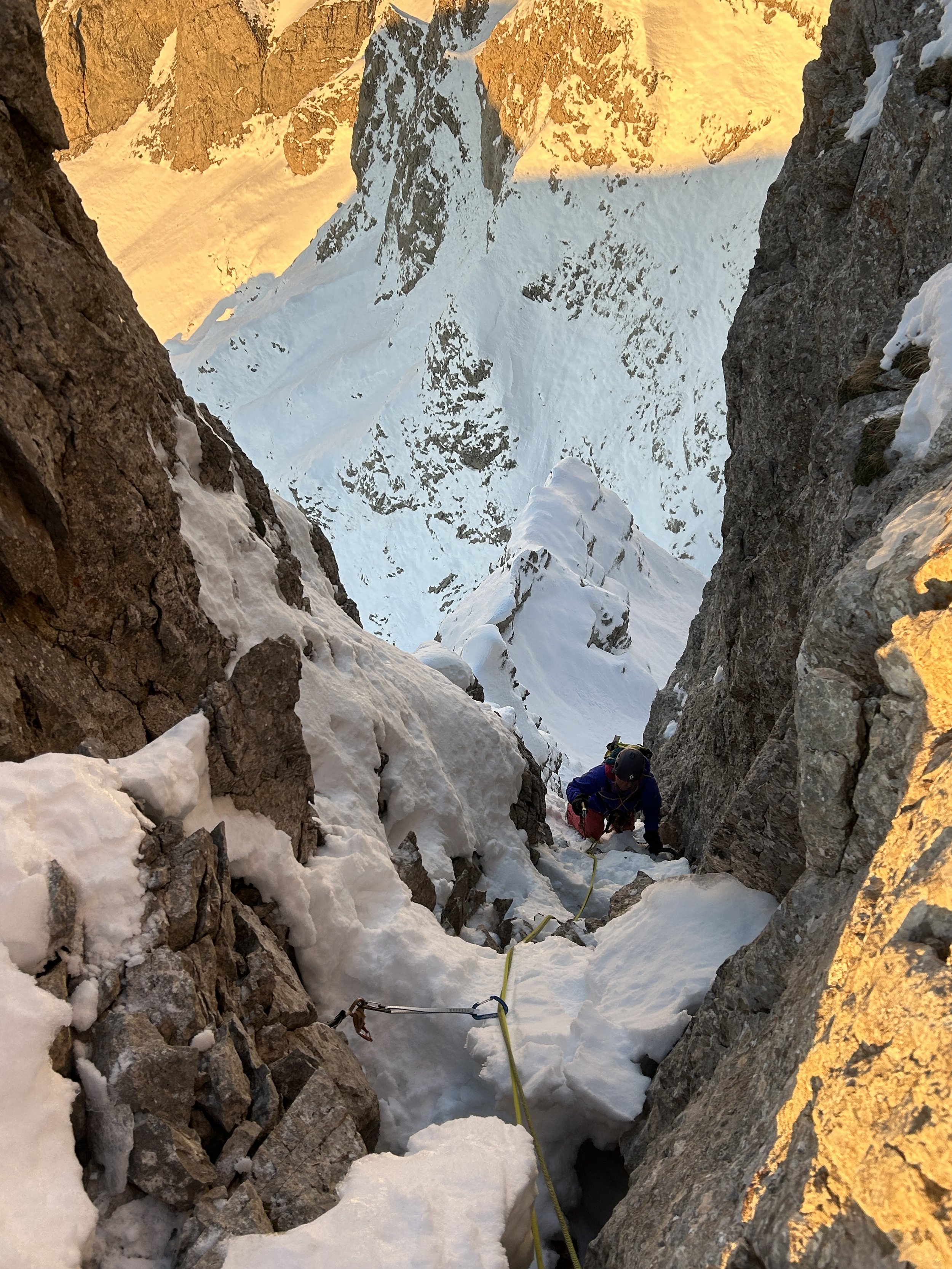
Above the overhang, the climbing stayed intense. I moved slowly, deliberately. At one point, I was stretched across the rock, hanging on one arm, crampons barely holding on a tiny edge, while my other hand placed a piton—the piece I truly needed. Higher up, I spotted a narrow ledge on the right, perfect for an anchor. To reach it, I climbed several meters without protection, opened my right leg as wide as I could, placed an ice axe on a solid hold, and made an awkward, almost acrobatic move onto safety. Knowing we were three climbers and that this pitch was serious, I built the anchor well enough to hold any weight on the world.
While Nikola and Elena climbed up, I studied the final pitch. The line continued through a dihedral above us. The only concern was the exit—onto a very narrow ridge, where building an anchor could be tricky. “Let’s see,” I said. “Let’s finish this well.” The last pitch wasn’t difficult. It flowed. Pure enjoyment. It reminded us that real alpine climbing exists right here, at home.
We topped out on a comfortable stance, facing west. It was 16:30. The sun was already low, the light deep and warm. As the three of us exited the route, safe and quiet, watching the sun sink behind the horizon, the name came naturally: Korab Sun. The difficulty of the route does not pass M5. Still, is up to others to embrace the adventure and prove its worth. From there, we reached the summit of Krcin and descended via the classical route, walking back to the village in complete darkness—tired, calm, and happy.